Bicentennial Eisenhower Dollar · America's 200th Anniversary · 1776–1976
The Bicentennial dollar that gave America a Liberty Bell reverse — and produced the rarest modern U.S. coin ever struck.
700M+
Total Minted
2 Types
Type 1 & Type 2 Varieties
$850K
No S Proof Estimated Value
4
Major Error Types
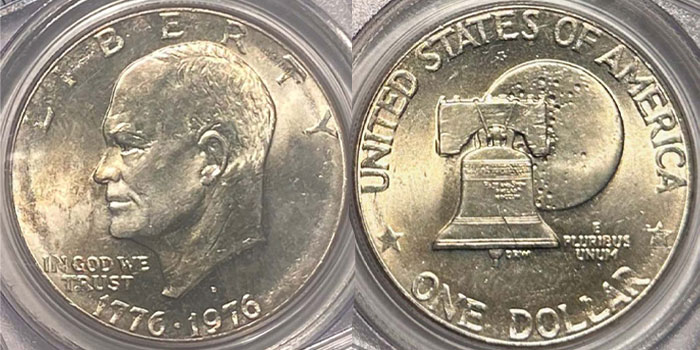
The 1776 to 1976 Bicentennial Eisenhower dollar is one of the most beloved commemorative coins in U.S. history, struck to celebrate America's 200th anniversary of independence. With a distinctive dual date and a unique Liberty Bell & Moon reverse designed by Dennis R. Williams, this dollar broke sharply from the standard eagle design used on regular Eisenhower dollars. NGC Coin Explorer provides comprehensive certification data for the 1776-1976 Type 1 Eisenhower dollar, including population reports and auction records across all grade levels.
Bicentennial dollars were produced from 1975 through 1976, all bearing the dual date 1776–1976. The Mint struck both clad and 40% silver collector versions, and an early production change in the reverse lettering created two distinct design types now catalogued as Type 1 and Type 2. For a comprehensive breakdown of current market values, the 1776 to 1976 dollar value guide at CoinValueApp covers certified auction data, grade premiums, and variety pricing in detail.
Find your coin scenario in 30 seconds
| What You See | Likely Value | Next Step |
|---|---|---|
| Proof qualities, no S mint mark (Type 2) | ~$850,000 | Immediate multi-expert authentication |
| 1976-D coin, weighs 24.6g (silver planchet) | $10,000–$30,000 | Weigh precisely, then NGC/PCGS authenticate |
| 40%+ off-center, dual date still visible | $2,500–$7,500 | Grade & certify with PCGS or NGC |
| Type 1 Philadelphia (bold lettering, no mint mark) | $35–$500 in high grades | Confirm Type 1 lettering; consider grading |
| 40% silver S-mint (from collector set) | $15–$100+ | All silver Bicentennials are Type 1 |
| Doubled die on date or LIBERTY | $50–$300 | Verify hub doubling vs. machine doubling |
| Circulated clad Type 2 dollar | $1–$5 | Face value; keep for type set |
Type 1 vs Type 2 — the most widespread distinction in the Bicentennial series
| Variety | Mint | Mintage (approx.) | Composition | Notes |
|---|---|---|---|---|
| Type 1 | Philadelphia | ~4M (est.) | Clad | Bold sans-serif reverse lettering; scarce |
| Type 1 | Denver | ~21M (est.) | Clad | Bold lettering; more common than Phila. Type 1 |
| Type 2 | Philadelphia | ~113M | Clad | Refined serif lettering; common |
| Type 2 | Denver | ~82M | Clad | Most common Bicentennial dollar |
| Type 1 | San Francisco | ~11M | 40% Silver | All S-mint silver Bicentennials are Type 1 |
| Proof Type 2 | San Francisco | ~4M | 40% Silver | Sold in special sets; must have S mint mark |
Market estimates based on verified auction records — circulated to gem uncirculated
| Grade | Philadelphia (No MM) | Denver (D) |
|---|---|---|
| Circulated (VF-XF) | $2–$8 | $2–$5 |
| MS-60–63 | $10–$25 | $8–$18 |
| MS-64 | $35–$60 | $20–$40 |
| MS-65 | $100–$200 | $50–$100 |
| MS-66+ | $300–$500+ | $150–$300 |
| Grade | Uncirculated (MS) | Proof (PR) |
|---|---|---|
| MS/PR-60–63 | $15–$25 | $20–$35 |
| MS/PR-64 | $25–$45 | $35–$60 |
| MS/PR-65 | $45–$80 | $60–$100 |
| MS/PR-66+ | $80–$200+ | $100–$300+ |
Four major error categories — from common doubled dies to the most valuable modern U.S. coin
The most widespread design distinction — bold vs. serif reverse lettering
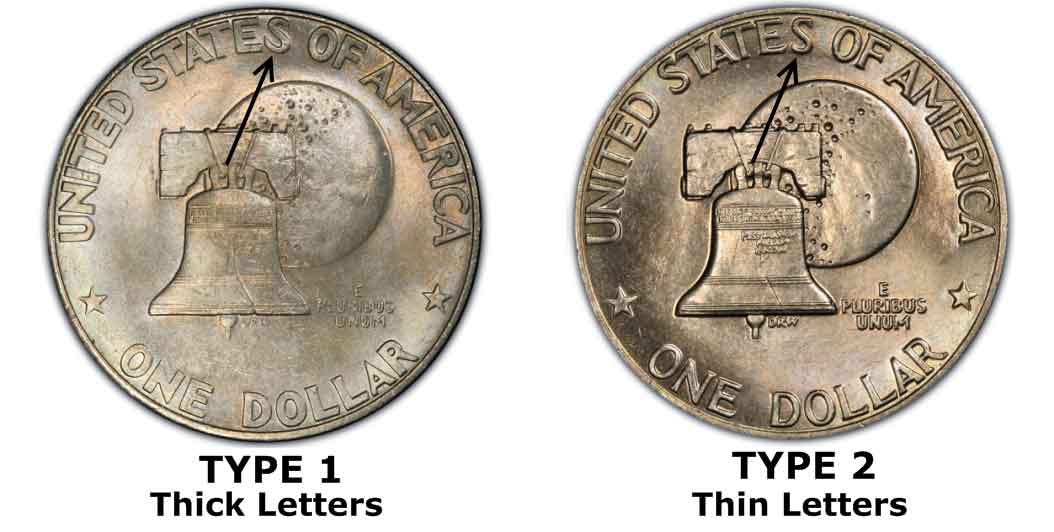
Type 1 (bold letters) vs Type 2 (serif letters) reverse comparison
Type 1 and Type 2 varieties stem from an early production change at the U.S. Mint. Type 1 features thick, blocky, bold sans-serif lettering on UNITED STATES OF AMERICA and ONE DOLLAR. The design was modified because it did not strike optimally on clad planchets. Type 2 introduced thinner, refined lettering with serifs that better matched the obverse font style.
How to identify: Use 5–10x magnification on the reverse lettering • Type 1 letters appear heavier with blunt ends • Type 2 letters have fine finishing strokes at the ends • Type 1 Philadelphia is the scarcest business strike • All 40% silver Bicentennials are Type 1 exclusively
Value: Type 1 Philadelphia MS-65+ $100–$500 — Type 2 circulated $1–$5
The rarest modern U.S. coin — one known specimen, estimated ~$850,000
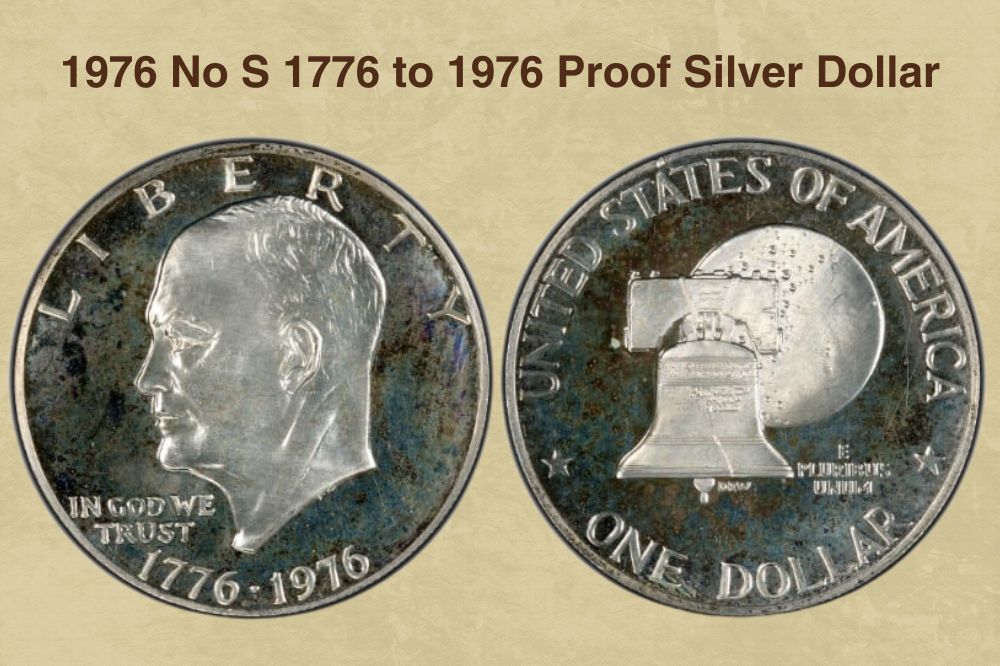
1776-1976 No S Proof Type 2 — mirror fields, frosted devices, no mint mark below Eisenhower's neck
The 1776–1976 No S Proof Type 2 Bicentennial dollar is perhaps the most significant modern U.S. coin rarity. Only one specimen is known, struck at the Philadelphia Mint as a trial piece during the transition from Type 1 to Type 2 design. On August 12, 1974, designers were permitted to strike trial proofs in Philadelphia, which is why this coin lacks the S mint mark found on all production proof Bicentennial dollars.
How to identify: Mirror-like fields and frosted design devices (cameo contrast) • Type 2 reverse with thin, serif lettering • No mint mark below Eisenhower's neck • No circulation wear whatsoever • Sharp, squared rims consistent with proof striking • Professional authentication is absolutely mandatory
⚠ Note: Philadelphia circulation strikes also have no mint mark. Only proof characteristics confirm this rarity.
Value: ~$850,000+ (graded PCGS PR66CAM — Mitchell Spivack collection)
Planchet misalignment creates dramatic blank crescents — the larger, the more valuable
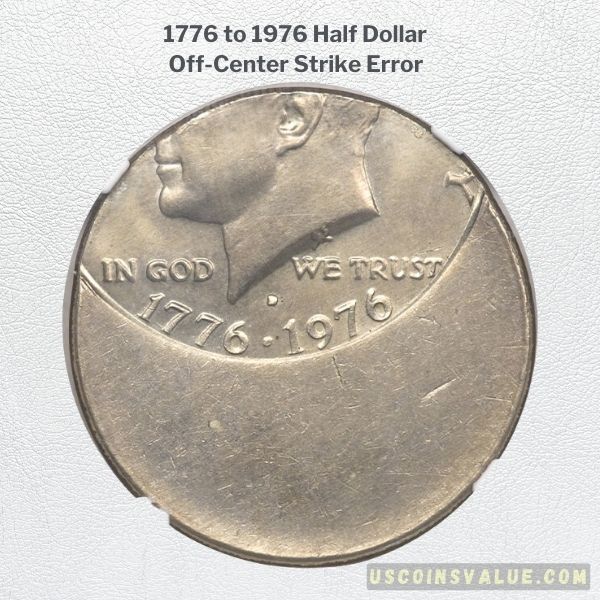
Off-center Bicentennial dollar — ~30% off with broadstrike, expanded to 42mm diameter
Off-center strike errors occur when the planchet is not properly positioned between the dies during striking, leaving a portion of the design missing and a blank crescent-shaped area on the coin. A notable 2016 auction example was struck approximately 30% off-center and also exhibited broadstrike characteristics — struck without the collar die — expanding the coin to 42mm instead of the standard 38mm diameter. The combination commands a premium over either error alone.
How to identify: Blank curved area showing original planchet surface • Design cleanly cut off (not worn away) • Both obverse and reverse show consistent misalignment • Verify the dual date 1776–1976 is still visible • Measure diameter — broadstrikes exceed 38.1mm • Edge reeding may be incomplete or absent on broadstruck examples
Value: 5–15% off: $100–$400 — 20–35% off: $500–$2,000 — 40%+ with date: $2,500–$7,500
Only 2 known examples — Denver clad dollar struck on a San Francisco silver planchet
1976-D struck on 40% silver planchet — weighs 24.6g vs. normal 22.7g for clad
The most extraordinary wrong planchet error in the Bicentennial series is the 1976-D dollar struck on a 40% silver planchet intended for San Francisco production. Only two examples are known, one graded AU58 and one Mint State. The error occurred when silver planchets from San Francisco were accidentally mixed with Denver's clad planchets. While approximately 45 Denver Mint Eisenhower dollars on silver planchets exist from other years, the Bicentennial date is exceptionally scarce.
How to identify: Weigh precisely — silver planchet: 24.6g vs. clad: 22.7g • Silver has a distinctly different sound when tapped • Examine the edge for the copper core visible in clad coins (absent in silver) • Silver planchets have different luster • Must have a D mint mark for this specific rarity • Be alert to silver-plated alterations — these are worthless
Value: $10,000–$30,000+ (1976-D on silver) — Other wrong planchet types: $500–$5,000

Verified public auction records — real market benchmarks for Bicentennial dollar errors
| Coin | Grade | Sale Price | Notes |
|---|---|---|---|
| No S Proof Type 2 | PCGS PR66CAM | ~$850,000 (est.) | Only known specimen; private collection |
| 1976-D on Silver Planchet | AU58 | $10,000–$30,000+ | One of only 2 known examples |
| Off-Center + Broadstrike (~30%) | MS | ~$7,000 | 2016 auction; 42mm expanded diameter |
| Type 1 Philadelphia MS-66 | PCGS MS-66 | $300–$500 | Scarce business strike, top pop grades |
| 40% Silver MS-67 | PCGS MS-67 | $150–$300 | Collector silver; all Type 1 |
| Doubled Die Variety | MS-64 | $50–$300 | Varies by strength & location of doubling |
“The 1776–1976 No S Proof Type 2 may be the most valuable modern U.S. coin in existence — a unique trial piece connecting America's Bicentennial celebration to the rarest of mint errors.”
Distinguish Type 1 vs Type 2, detect off-center percentages, and verify proof characteristics in seconds
Snap Both Sides
CoinKnow instantly identifies Type 1 vs Type 2 reverse lettering using side-by-side reference images from its database, eliminating guesswork on the most common Bicentennial question.
Detect Errors
Automatic detection for doubled dies, off-center percentage measurement, and proof characteristic verification. Weight specs help you flag potential wrong planchet candidates.
Track Auction Values
Real-time auction tracking from Heritage, GreatCollections, and major houses. Monitor price trends for Bicentennial dollar errors and varieties over time.
The most valuable is the No S Proof Type 2, with only one known specimen estimated at approximately $850,000. The 1976-D struck on a 40% silver planchet is extremely rare with only two known examples worth $10,000–$30,000. Off-center strikes with visible dual dates can reach $7,500, while Type 1 Philadelphia varieties in high grades command $100–$500 premiums.
Examine the reverse inscription lettering (UNITED STATES OF AMERICA and ONE DOLLAR) under 5–10x magnification. Type 1 has thick, bold, sans-serif letters with no decorative finishing strokes. Type 2 has thinner letters with small serifs at the ends. The CoinKnow app includes side-by-side comparison images to make this identification straightforward.
Most no-mint-mark Philadelphia Bicentennial dollars are worth $1–$5 in circulated condition. However, Type 1 Philadelphia issues are scarcer and worth $35–$500 in high grades. The key exception is the unique No S Proof Type 2, worth hundreds of thousands — but that coin must also show undeniable proof characteristics, not just the absence of a mint mark.
The 1776–1976 No S Proof Type 2 is estimated at approximately $850,000 or more. It was graded PCGS PR66CAM and resides in the Mitchell Spivack private collection. It is considered possibly the rarest modern U.S. coin. Due to its unique status, its value at auction could exceed even this estimate. Professional authentication is absolutely essential — do not assume any coin is this rarity without expert examination.
Yes, though they are not as dramatic as in some other U.S. series. Doubling typically appears on the date digits, LIBERTY lettering, or elements of the Liberty Bell design on the reverse. True doubled dies show clear separation between design elements, not the shelf-like appearance of machine doubling. Most examples are worth $50–$300 depending on doubling strength and coin grade.
What most 1776–1976 dollars are actually worth — and when to act
| Scenario | Realistic Value | Action |
|---|---|---|
| Proof characteristics + no S mint mark (Type 2) | ~$850,000 | Immediate multi-expert authentication required |
| 1976-D, weighs 24.6g (silver planchet) | $10,000–$30,000+ | Weigh precisely; PCGS or NGC authenticate |
| Dramatic off-center (40%+), date visible | $2,500–$7,500 | Grade and certify; value depends on % |
| Type 1 Philadelphia MS-65+ | $100–$500 | Confirm Type 1; send for certification |
| 40% silver S-mint, MS-65+ | $60–$200 | All Type 1; consider grading in gem condition |
| Circulated clad Type 2 dollar | $1–$5 | Keep for type set; common coin |
The 1776 to 1976 Bicentennial Eisenhower dollar occupies a unique place in American coinage history: a coin born from celebration that produced one of the most extraordinary errors in modern numismatics. For most collectors, the Bicentennial dollar is an affordable and historically rich series — accessible in circulated condition, rewarding in gem grades, and fascinating through its Type 1 and Type 2 variety collecting. But hovering above every proof Bicentennial dollar is the shadow of a single, extraordinary coin: the No S Proof Type 2, whose singular existence makes it the pinnacle of modern U.S. rarity.
“The 1776 to 1976 Bicentennial dollar is simultaneously one of America's most beloved commemoratives and home to its most valuable modern mint error — a coin that celebrates 200 years of independence while hiding the rarest proof ever struck.”